
In this article
- 1. What is Annual Return Filing in Singapore?
- 2. Which Companies Need to File an Annual Return?
- 3. When is the Annual Return Filing Deadline?
- 4. Does My Company Need to Hold an AGM Before Filing?
- 5. Do I Need to File Financial Statements with my Annual Return?
- 6. Does My Company Need Audited Accounts?
- 7. How Do I File the Annual Return on BizFile+?
- 8. How Much Does it Cost, and What Happens if I File Late?
- 9. What Mistakes Usually Cause Late Filing?
- 10. Can I File the Annual Return Myself?
- 11. Annual Return Filing FAQs
Every company incorporated in Singapore has to file an annual return with ACRA once a year. It doesn’t matter if the business had a busy year, a quiet one, or hasn’t started trading yet.
The filing itself usually takes an hour or two. What causes trouble is the stuff around it: accounts that aren’t ready, a deadline nobody tracked, or confusion over whether an AGM is needed. This guide walks through annual return filing in Singapore for 2026 so you know exactly what to prepare and when.
What is Annual Return Filing in Singapore?
An annual return is a yearly update you submit to ACRA through the BizFile+ portal. It confirms your company’s details on the public register, which banks, investors and suppliers check when they want to verify a business.
Your annual return covers:
- Company name, UEN and registered office address
- Principal activities and SSIC code
- Directors, company secretary and shareholders
- Share capital and any changes during the year
- Financial year end (FYE)
- AGM date, or the date financial statements were sent to members
- Financial statements, unless your company is exempt
It’s not the same as your tax return. Corporate income tax goes to IRAS on its own timeline, so you’ll need to handle that separately through corporate tax filing.
Which Companies Need to File an Annual Return?
Every company incorporated in Singapore, with no size or revenue exemption. That includes:
- Private limited (Pte Ltd) and public companies
- Dormant companies with no transactions
- Companies whose owners or directors live overseas
- Companies that have dispensed with their AGM
Sole proprietorships and partnerships don’t file one. LLPs file an Annual Declaration instead, and foreign company branches follow a different set of rules.
Also check: Sole Proprietorship Registration in Singapore
When is the Annual Return Filing Deadline?
The deadline is counted from your own FYE, not a fixed date on the calendar. That’s the main reason companies miss it.
| Company type | Deadline after FYE |
| Non-listed (includes all private companies) | 7 months |
| Listed | 5 months |
| Non-listed with a branch register outside Singapore | 8 months |
| Listed with a branch register outside Singapore | 6 months |
Here’s how that works out for a private company with some common year ends:
| FYE | AGM by (if holding one) | Annual return due |
| 31 Dec 2025 | 30 Jun 2026 | 31 Jul 2026 |
| 31 Mar 2026 | 30 Sep 2026 | 31 Oct 2026 |
| 30 Jun 2026 | 31 Dec 2026 | 31 Jan 2027 |
| 30 Sep 2026 | 31 Mar 2027 | 30 Apr 2027 |
For a newly incorporated company, the first annual return is due 7 months after its first FYE. Keep in mind that the first financial year can’t run longer than 18 months from the date of incorporation.
Does My Company Need to Hold an AGM Before Filing?
Not always. A private company doesn’t have to hold an AGM if either of these applies:
- All members have passed a resolution to dispense with AGMs
- The company sends its financial statements to all members within 5 months of FYE
A member can still ask for an AGM, as long as they give notice at least 14 days before the end of the sixth month after FYE. Whether or not you hold one, the annual return deadline doesn’t move. You just record the AGM date or the date the financial statements went out.
Do I Need to File Financial Statements with my Annual Return?
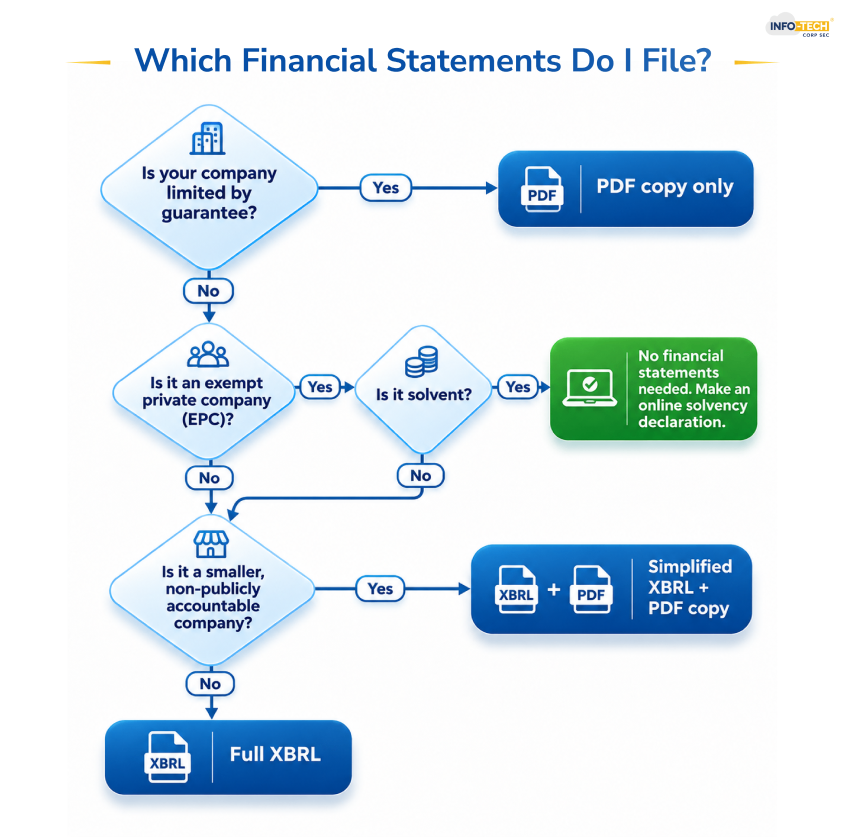
Most companies do, but the format depends on what kind of company you are.
| Company type | What to file |
| Most Singapore companies | Financial statements in XBRL. Smaller, non-publicly accountable companies can use the simplified XBRL template plus a PDF copy |
| Solvent exempt private company (EPC) | No financial statements needed. You make an online solvency declaration instead |
| Insolvent EPC | Financial statements in XBRL |
| Company limited by guarantee | PDF copy only |
| Banks and insurers regulated by MAS | Industry XBRL template plus a PDF copy |
| Dormant company that qualifies under section 201A | May be exempt from preparing financial statements at all |
An EPC is a private company with no more than 20 shareholders, none of which is a corporation.
If you prepare XBRL in-house, ACRA’s updated BizFinx PrepTool and Multi-Upload Tool had to be adopted by 15 April 2026. Older versions may cause validation errors when you upload.
Does My Company Need Audited Accounts?
Only if it doesn’t qualify as a small company. A private company counts as small if it meets at least two of these three for each of its last two financial years:
- Annual revenue of S$10 million or less
- Total assets of S$10 million or less
- 50 employees or fewer
If your company is part of a group, the whole group also has to qualify as small on a consolidated basis. Otherwise even a tiny subsidiary loses the exemption.
Skipping the audit doesn’t mean skipping the accounts. Unaudited statements still need to be prepared, approved by the directors and sent to shareholders. Clean bookkeeping through the year makes this quick, and if you do need an audit, audit support helps you get the documents to your auditor on time.
How Do I File the Annual Return on BizFile+?
Have these ready before you log in: your Singpass or Corppass access, the final financial statements (XBRL and PDF), and your AGM date or the date the statements were circulated.
- Log in to BizFile+ and go to Annual Filing, then choose to file annual returns for a local company.
- Check the pre-filled company details, FYE and company type.
- Declare your status, such as small company, solvent EPC or dormant.
- Enter the AGM details, or confirm the exemption you’re relying on.
- Upload your financial statements, or declare that you’re exempt.
- Confirm directors, secretary, shareholders, registered charges and your register of controllers.
- Review everything, tick the declaration and pay the filing fee.
- Download your acknowledgement as proof of lodgement.
Any change to directors, shareholders or your address should already have been filed within 14 days of it happening. The annual return is where you confirm the record is right, not where you catch up on a year of changes.
How Much Does it Cost, and What Happens if I File Late?
Filing on time costs S$60. Filing late adds a penalty on top, charged automatically when you submit.
| Item | Amount |
| Annual return filing fee | S$60 |
| Late by up to 3 months | S$300 penalty |
| Late by more than 3 months | S$600 penalty |
| Extension of Time (up to 60 days) | S$200 per application |
If you can see the deadline slipping, apply for an Extension of Time on BizFile+ at least 14 working days before the due date.
Ignoring it makes things worse. ACRA can then:
- Offer a composition sum or take the company to court, with fines of up to S$5,000 per charge
- Disqualify directors who rack up three or more filing offences within five years
- Strike the company off the register
What Mistakes Usually Cause Late Filing?
It’s rarely carelessness. It’s usually one of these:
- Accounts finished too late. You can’t file until the financial statements are done, so a messy year end eats into your buffer.
- Mixing up ACRA and IRAS. Filing your tax return doesn’t tick off the annual return, and the other way round.
- Advisers working separately. When your accountant, auditor and secretary aren’t talking, statements arrive after the AGM or filing window has closed.
- An outdated SSIC code. If the business has changed direction, the activity code should change too, or you may run into grant and licensing issues.
- Share records out of sync. Undocumented transfers or allotments tend to surface during bank applications or due diligence.
Can I File the Annual Return Myself?
Yes, a director or company secretary with the right access can file directly on BizFile+. Most SME owners still hand it over to their company secretary, which every Singapore company must appoint within six months of incorporation anyway.
A good secretary keeps your compliance calendar, chases the accounts, files changes within the 14-day window and lodges the annual return before it’s due. At Info-Tech Corp, our corporate secretary services cover annual return filing from start to finish, and our accounting and tax teams prepare the numbers it depends on. Get in touch and we’ll make sure your 2026 filing is one less thing to think about.
Book a Free ConsultationAnnual Return Filing FAQs
Private (non-listed) companies must file their annual return within 7 months after their financial year end, while listed companies have 5 months. So if your FYE is 31 December 2025, your annual return is due by 31 July 2026. Companies with a branch register outside Singapore get an extra month (8 months for non-listed, 6 months for listed).
Subtract the starting value of your investment from the ending value, add any income received such as dividends, then divide by the starting value and multiply by 100. For example, if S$10,000 grows to S$10,800 and pays S$200 in dividends, the annual rate of return is 10%. For investments held over several years, use the annualized formula instead: (ending value ÷ starting value)^(1 ÷ number of years) − 1.
Every company incorporated in Singapore must file an annual return with ACRA each year, whatever its size or revenue. This includes private limited and public companies, dormant companies, companies with overseas owners or directors, and companies that have dispensed with their AGM. Sole proprietorships and partnerships don’t need to file one, while LLPs file an Annual Declaration instead.
You file your annual return online through ACRA’s BizFile+ portal, using Singpass or Corppass. Log in, go to Annual Filing and select the option to file annual returns. Check your company details, enter your AGM information, upload your financial statements (or declare that you’re exempt), then pay the S$60 filing fee. Once submitted, download the acknowledgement as proof of filing.
