

In this article
- 1. What is a Dividend in Singapore?
- 2. What are the Types of Dividends in Singapore?
- 3. What are the Legal Requirements for Declaring Dividends in Singapore?
- 4. What is the Procedure to Declare Dividends in Singapore?
- 5. What are the Documents Required to Declare Dividends in Singapore?
- 6. Dividends – FAQs
When a company makes profit, one way to share rewards with the shareholders is to distribute a portion of profit as dividends. However, declaring a dividend does not just mean transferring money from company’s bank account to shareholder’s account.
Companies must follow the Singapore Companies Act 1967, review the financial position of the company, obtain necessary approvals and maintain proper documentation.
Understanding how to declare dividends in Singapore can help business owners distribute profits responsibly while meeting all the legal and financial requirements.
Read Also: Company Registration in Singapore: 2026 Guide
What is a Dividend in Singapore?
A distribution of company’s profit to the shareholders is called the dividend. A dividend allows the shareholders to get a return on their investment without selling their shares. Dividends are generally distributed based on the rights or number of shares they hold according to the company’s constitution or share structure.
Dividends are not the salaries or business expenses for the services provided to the company. Instead, they are the distributions of profits.
What are the Types of Dividends in Singapore?
Companies in Singapore may provide different types of dividends based on the financial position and constitutions of the company.
Final Dividend:
Final dividends are usually declared after reviewing the financial position of the company after the end of the financial year. They are usually associated with the annual financial results.
The directors declare the dividend amount, and they are submitted to the shareholders in the general meeting.
Interim Dividends:
Interim dividends are distributed before the end of the financial year or between the annual dividend declaration. This allows companies to distribute profit to the shareholders without waiting until the end of the financial year.
This is distributed only when the board of directors approve as per the constitution of the company.
Special Dividend:
A special dividend is a one-time distribution of profit to the shareholders when the company is accumulated with substantial profits or an exceptional gain during the financial year. However, the distribution of special dividends must satisfy all the legal requirements.
What are the Legal Requirements for Declaring Dividends in Singapore?
Dividends Must be Paid out of Profit:
Before declaring dividends in Singapore, the companies must ensure that proposed distribution of dividends comply with Singapore’s corporate regulations.
Under Section 403 of the Singapore Companies Act 1967, dividends can be paid or only out of the profit. The companies should thoroughly analyse the financial statement and declare the dividend only if enough profit is available as per the legal requirements.
The companies should not assume that they have enough money to distribute to the shareholders just because the money is available in the bank account.
Review the Financial Position of the Company:
Before declaring the dividend, the directors must review the financial statements and assess the financial health of the company. The directors must ensure that the distribution does not affect its ability to meet the financial obligations.
Follow the Company’s Constitution:
The companies may have different rights for ordinary and preference shareholders. Als the companies may specify how the dividends must be recommended, approved and distributed. So, the companies must review and follow these provisions before proceeding to distribute.
Obtain Necessary Approvals:
The approval necessities may vary based on the type of dividend and the company’s constitution. Generally final dividends require approval from the shareholders followed by the recommendation of the directors. Whereas interim dividends require the approval directly from the board of directors.
What is the Procedure to Declare Dividends in Singapore?
Declaring dividends in Singapore require proper assessment of financial records, corporate approvals and record-keeping.
Begin by review the financial statements to determine whether enough profit is available to distribute. This helps to understand if the proposed dividend can be lawfully distributed.
Once the available profits have been assessed, decide how much the company intends to distribute.
The directors should review the proposed dividend and determine whether the amount is appropriate.
If the dividend requires approval from the shareholders, the company must follow the procedures specified in the constitution.
After obtaining all the required approvals, the company should prepare relevant dividend records.
Once the proposal is validly approved and becomes payable, the company can proceed with the payment to the eligible shareholders.
After declaring and paying the dividends, the company must update the accounting records.
What are the Documents Required to Declare Dividends in Singapore?
Maintaining a proper record of dividend declaration is an important part of corporate governance.
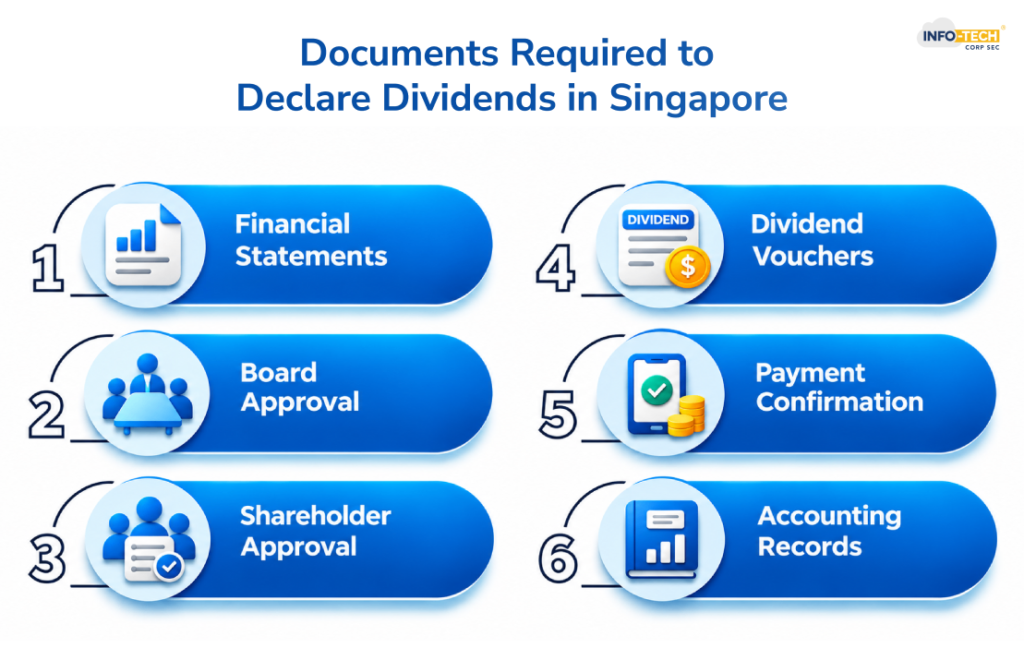
The documents commonly include,
Financial Statements: To confirm that the company has sufficient profits to distribute.
Board Approval: To record the director’s approval or recommendations for dividend distribution.
Shareholder Approval: To record the approval of shareholders when required.
Dividend voucher: To show the amount distributed to each shareholder.
Payment proof: To provide a proof that the dividend has been paid.
Accounting Records: To record dividend payments accurately in the company’s financial accounting.
Dividends – FAQs
A company may declare dividends during the financial year or after the end of the financial year, provided it follows all the legal requirements and follow the constitution.
Generally, no. As per section 403 of the companies act, dividends must be paid out of profits. The companies must establish that sufficient profits are available for distribution.
Not necessarily. Final dividends generally require approval from the shareholders. While interim dividends may be approved by the directors if authorised.
No. Dividends are distributed out of profits to the shareholders and are not deductible business expenses for corporate tax filing purposes., all data can be accessed at anytime, anywhere.