
In this article
- 1. What is a Sole Proprietorship?
- 2. Who Can Register a Sole Proprietorship in Singapore?
- 3. What is the Information Required to Register a Sole Proprietorship?
- 4. How to Register a Sole Proprietorship in Singapore?
- 5. How is a Sole Proprietorship Taxed in Singapore?
- 6. What are the Common Mistakes to Avoid While Registering a Sole Proprietorship?
- 7. Sole Proprietorship – FAQs
Starting a business in Singapore involves taking several important decisions, and one of the first is to decide the structure of the business. The individuals who want to run a business independently, sole proprietorship is the simplest option available.
This business structure allows individuals to own and operate the business without establishing a company. This structure is often preferred by freelancers, consultants, small retailers and entrepreneurs who wants a straightforward business.
This guide explains how to register a sole proprietorship in Singapore, including step by step processes through ACRA, documents required and what to do after registration.
What is a Sole Proprietorship?
A sole proprietorship is a business owned by a single person. It is not a separate legal entity from the owner. This means that the owner and the business are legally considered the same person.
The owner receives all the profit generated by the business and is personally responsible for its debts and liabilities. This has a relatively simple structure. So, this type of business is generally suitable for freelancers, consultants, small retail businesses or individual service providers.
However, the owners should consider the unlimited personal liability that is involved with this business structure.
Who Can Register a Sole Proprietorship in Singapore?
According to Accounting and Corporate Regulatory Authority (ACRA), individuals registering for this business type in Singapore should be at least 18 years old. The main requirements for registration may vary depending on whether the owner is a Singapore resident or a foreigner.
For local applicants, eligible owners may include Singapore citizens, Singapore permanent residents and FIN holders who meet certain requirements. FIN holders must check with their issuer before registering a business.
Individuals who register for a sole proprietorship should not be an undischarged bankrupt. Self-employed individuals must ensure that certain requirements are properly arranged before registering or renewing their business.
Read Also: Company Registration in Singapore: 2026 Guide
What is the Information Required to Register a Sole Proprietorship?
Before starting the registration process, it is important to have certain information handy. It generally includes,
- An approved business name
- Proposed date of commencement
- Email address for the business
- Owner’s identification details
- Owner’s residential and contact details
- Business operating address
- Details of business branches, if applicable
Businesses operating in residential premises may also need approval to use home address as a business address.
How to Register a Sole Proprietorship in Singapore?
The sole proprietorship registration is completed online through ACRA’s Bizfile portal.
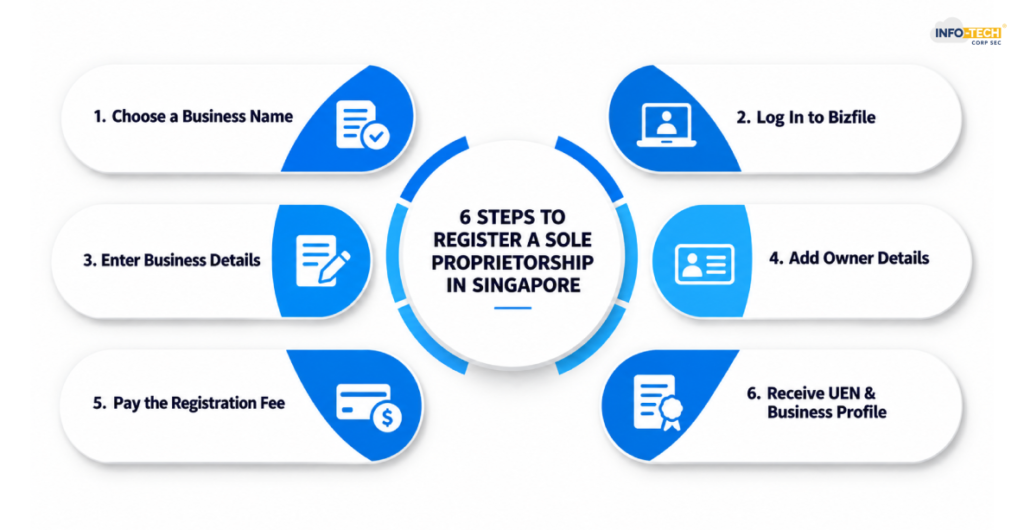
Step 1: Start by choosing a relevant name for the business. The name should represent the business and avoid any misleading, undesirable or too similar ones with the already registered business names. First, you must submit the name that you have decided to the Bizfile for approval. The current application fee for business entity is S$15. Once the name is approved, you can proceed with the registration.
Step 2: Go to ACRA’s Bizfile portal and login to your Singpass. From the portal, select the option the register a new business entity.
Step 3: Enter the required details about the business, this may include details like business commencement date, business operation address, business activities and details about the owners.
Step 4: As this business structure has only one owner, you will need to provide details about the owner. This usually includes the personal details, identification information and contact address.
Step 5: Review all the information given before submitting the application. The current registration fee is S$100 for a one-year registration and S$160 for a three-year registration. But the three-year registration is permitted only when certain conditions are met.
Step 6: If you want a straightforward registration, you can proceed shortly after making the payments. However, there are certain application that may require additional approval from the authorities. These types of registrations may take a bit longer to complete the process.
What Happens After?
ACRA states that complex registrations may take15 working days, while the registrations that require referral to another authority take 14 to 60 days.
Once the registration is approved, you will receive,
- Confirmation on successful registration
- A Unique Entity Number (UEN)
- Access to a free copy of your business profile
A UEN is important when dealing with the government agencies for any business transactions.
How is a Sole Proprietorship Taxed in Singapore?
A sole proprietorship does not pay corporate income tax as a separate company.
Instead, the profits of the business are treated as a personal business income of the owner and taxed under individual income tax rates.
Business incomes are not treated as employment salary. Self-employed individuals and sole proprietors generally report their business incomes under relevant trade, business or profession.
What are the Common Mistakes to Avoid While Registering?
The following are some of the common mistakes to avoid during registration,
Choosing a business structure without understanding that an individual must borne the entire liability of the business.
Providing incorrect information during the registration processes.
Selecting inaccurate or irrelevant business activities.
Some of the business activities may require licenses. So, forgetting to check license requirements can become a major mistake.
Mixing the personal and business financial records. The owner’s personal and business records must be maintained separately.
Missing registration renewal deadlines. Ignoring GST registration when the business grows.
Sole Proprietorship FAQs
Most straightforward applications can usually be processed within one working day after the payment. While the applications requiring additional approvals may take longer up to 60 days.
No. A sole proprietorship is not taxed as a separate company. Business profits are treated as the owner’s personal income, and they are taxed according to the individual’s income tax rates.
No, for a sole proprietorship it is not always mandatory to have a separate bank account. But it is recommended to have one, as it helps to keep the personal and business transactions separate.
Yes, sole proprietors should maintain proper accounting records of income, expenses, invoices, receipts, bank transactions and other business documents. These records generally need to be retained for at least five years.