
In this article
Running a business in Singapore comes with several tax responsibilities and one of such is knowing when GST registration becomes necessary.
The current Goods and Service Tax (GST) rate in Singapore is 9%. GST registered businesses can charge GST on their standard-rated supplies and can claim eligible GST on business purchases as input tax.
What is GST Registration?
GST registration in Singapore is the process of registering a business with Inland Revenue Authority of Singapore (IRAS) so that it can account for Goods and Services Tax.
Once it becomes effective, the business must charge GST on its standard-rated supplies. At the same time, it may claim GST charges on eligible business expenses, purchases and imports as per Singapore’s input tax rules.
Businesses are authorised to collect and charge GST on customers only if the business is GST registered.
Read Also: Company Registration in Singapore: 2026 Guide
Who Needs GST in Singapore?
One of the most important questions for businesses is whether GST is compulsory.
Generally, a business must register for it when its taxable turnover exceeds S$1 million under applicable registration tests.
There are two main ways for Singapore businesses to become GST registered.
- Compulsory GST registration
- Voluntary GST registration
When the taxable turnover exceeds S$1 million, the GST registration becomes compulsory. IRAS assesses this using the following two tests,
Retrospective view: Taxable turnover exceeds S$1 million in the calendar year.
Prospective view: Taxable turnover is reasonably expected to exceed S$1 million during the next 12 months.
Retrospective view:
Under the retrospective view, businesses look at their turnover for the calendar year from 1st January to 31st December. If the turnover exceeds S$1 million, the businesses must apply for registering from 1st January to 31st December of the following year.
Prospective View:
The businesses may apply for registration, if it can reasonably expect for the turnover to hit S$1 million in the next 12 months.
This means that the businesses need not wait for registering until the sales value hits S$1 million.
What Counts as Taxable Turnover?
Understanding what constitutes taxable turnover is important because the S$1 million threshold applies only to the taxable turnover and not to the total amount of every transaction.
This includes,
- Standard-rated supplies
- Zero-rated supplies
Excludes,
- Exempt-supplies
- Out-of-scope supplies and
- Sales of capital assets.
What are the Benefits of Voluntary GST Registration?
One potential benefit of voluntary GST registration is the ability to claim eligible GST incurred on business purchases. It is subjected to conditions for claiming the input tax.
This becomes an important consideration for businesses that regularly incur GST on purchases and expenses. However, if the company registers for GST, it should comply with the GST obligations as well. So, the decision should be taken based on specific circumstances.
Voluntary registrants must remain GST-registered for at least two years and must comply with all the applicable GST regulations.
How to Apply for GST-Registration in Singapore?
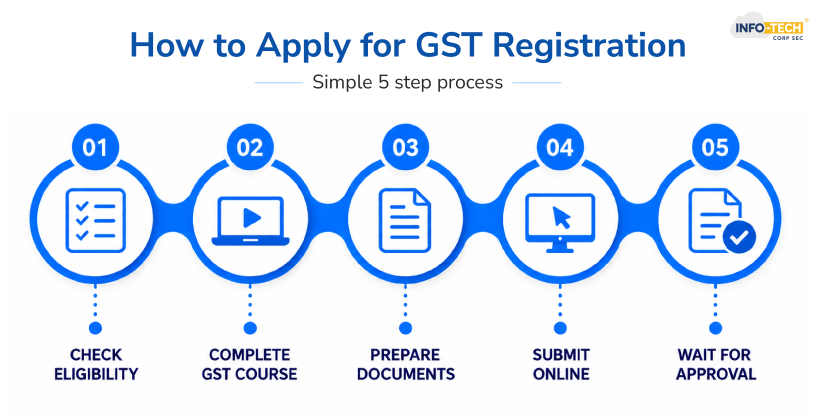
Businesses can apply for GST-registrations through IRAS’s digital services platform. The general process includes the following steps,
Step 1: Determine whether your business needs GST registration based on its taxable turnover, or it is voluntarily applying.
Step 2: Business applying for voluntary GST registration must complete the IRAS’s “Overview of GST” e-Learning course and quiz.
Step 3: Businesses should have the supporting documents for application in the digital format.
Step 4: The GST registration application must be submitted to the IRAS’s digital services, and the businesses should have the appropriate authorisation to assess the GST registration services.
Step 5: IRAS reviews the application and the supporting information. The time to complete the process may vary depending on the application and whether any additional information is required.
Once approved, the businesses will receive the registration number and the effective date of registration.
What are GST Obligations?
In Singapore, GST compliance and filing are the responsibilities that the businesses should follow.
The following are the main obligations,
- Business must provide proper tax invoices to GST- registered customers when required.
- Claim the incurred GST on eligible business purchases and expenses.
- All the GST registration processes and the accounting details must be kept up to date.
- The taxable turnovers and any other circumstances that may affect the GST obligations must be monitored regularly.
Contact Info-Tech Corporate Services for your GST registration.
Singapore GST Registration – FAQs
In Singapore. GST registration becomes compulsory when the business’s taxable turnover exceeds S$1 million under the retrospective and prospective registration test.
Yes, eligible businesses may voluntarily register for GST even if their taxable turnover in less than S$1 million.
IRAS states that 60% of the GST registration applications are processed within 10 working days while the remaining applications are processed within 30 days if all the documents and information are provided.
If a business fails to register for GST on time in Singapore, it faces backdated tax liabilities, financial penalties, and potential legal prosecution by the IRAS.