
In this article
- 1. What is the Singapore Tax Bracket?
- 2. What is Marginal Tax?
- 3. What are the Resident Income Tax Rates for the Year 2026?
- 4. How Gross Income Differs from Chargeable Income?
- 5. Who is a Singapore tax resident?
- 6. How does Non-residents Tax work in Singapore?
- 7. What Tax Reliefs Can Reduce Chargeable Income?
- 8. What are the Roles of Employers and Payroll Teams in Tax Brackets?
- 9. How Info-Tech Corporate Services Manage IRAS Requirements, Payroll and Accounting?
- 10. Singapore Tax Brackets -FAQs:
Singapore follows a progressive tax system. According to this system, the tax we pay will gradually increase as our chargeable income rises. But it does not mean that the tax on entire income will be at a higher rate when you move into a higher tax bracket.
What is the Singapore Tax Bracket?
The Singapore Tax Bracket is the range of chargeable income for individuals in Singapore to which different tax rates apply.
Singapore follows a progressive tax system. It means that a single tax rate will not apply to the entire income. Instead, the tax rate will vary from one range of chargeable income to another.
For example,
If your chargeable income is S$100,000, you need not pay 11.5% tax on the entire S$100,000. The tax for first portion of your income, S$20,000, is at 2%; the next portion at 3.5%; and the portion above S$100,000 at 7%. However, only the amount above S$80,000 and within S$100,000 will be taxed at 11.5%.
What is Marginal Tax?
It is important to understand that the marginal tax rate and the actual tax paid are not the same. The tax rate applied to the highest range of your chargeable income is the marginal tax rate. The same rate is not applied for rest of the income.
What are the Resident Income Tax Rates for the Year 2026?
The following is the resident income tax rate applicable for individuals in Singapore from YA 2024 and therefore applicable to YA 2026 as well. It is important to note that the tax rates shown against each bracket apply only to the respective incomes that fall within the band.
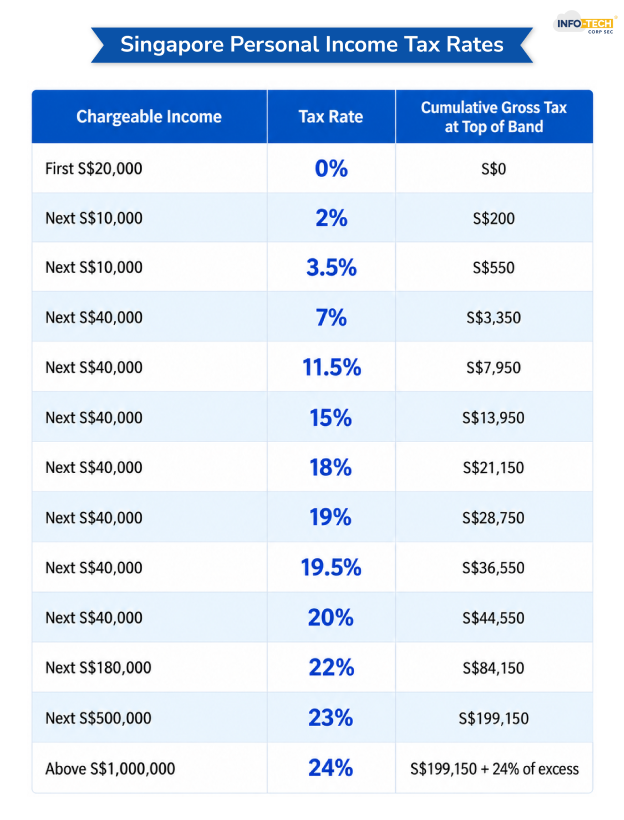
Tax Calculation in Singapore
Consider the chargeable income of an individual is S$100,000.
The tax calculation would be as follows,
First S$20,000 × 0% = S$0
Next S$10,000 × 2% = S$200
For the next S$10,000 × 3.5% = S$350
Next S$40,000 × 7% = S$2800
Next S$20,000 × 11.5% = S$2300
So, the total gross tax payable would be,
S$0 + S$200 + S$350 + S$2,800 + S$2,300 = S$5,650
Although the marginal tax rate is 11.5% in this scenario, the total tax rate is only 5.65%. That is why moving to a higher salary will not simply mean their chargeable income is taxed at the new rate.
How Gross Income Differs from Chargeable Income?
Gross income is the total annual income of an individual. Whereas chargeable income is something that we arrive at after deducting the allowable expenses and personal reliefs. Therefore, two employees with the same gross salary may end up with different chargeable incomes as the allowable deductions and personal reliefs may differ from one to the other.
Who is a Singapore Tax Resident?
Generally, Singapore citizens or permanent residents who normally reside in Singapore are the tax residents. Foreigners may also qualify as tax residents if they have stayed or worked in Singapore for at least 183 days in the previous calendar year. Your income is taxed based on the status of your residency in Singapore. Whereas Individuals who do not meet the conditions to be tax residents will fall into the category of non-tax residents.
How Does Non-residents Tax Work in Singapore?
The non-residents in Singapore will not pay tax the same as the tax-residents. For employment income for non-residents are at 15%. The tax for director’s fees, consultation fees and other types of income is 24% at present for non-residents. So, we should understand that the Singapore tax bracket does not apply to all employees or employers just because they work in Singapore.
What Tax Reliefs Can Reduce Chargeable Income?
Eligible personal tax reliefs reduces the total amount of tax that has to be paid. But this applies only to eligible Singapore residents who meet the qualifying conditions.
Tax reliefs should not be confused with tax rebates. Tax relief reduces the chargeable income before the tax rate is applied. Whereas a tax rebate reduces the tax payable after the initial tax calculations.
What are the Roles of Employers and Payroll Teams in Tax Brackets?
The personal income tax is assessed on individuals. However, employers and payroll teams play important roles in the process. Maintaining accurate payroll records helps employees prepare their information records, and they do not need to reconstruct the records at the end of the year.
Employers participating in Singapore’s Auto-Inclusion Scheme (AIS) must submit the employment records to the IRAS.
How Info-Tech Corporate Services Manage IRAS Requirements, Payroll and Accounting?
Manually calculating salaries, handling CPF contributions, and managing other statutory payroll information can create unnecessary administrative work. Also, the manual accounting processes may increase the risk of errors.
Info-Tech Corporate services help businesses in Singapore manage their payroll and accounting systematically. The services include monthly payroll processing, IRAS payroll compliance, CPF and statutory fund processing.
The accounting and bookkeeping services help businesses organise transactions and maintain accurate records for reporting and compliance purposes. Info-Tech Corporate Services is one reliable option.
Read Also: Form C and Form C-S: Corporate Tax Return Filing
Understanding Singapore’s tax brackets is important for employees. However, the systematic administration is equally important for businesses to maintain employment records.
Singapore Tax Brackets -FAQs
Tax brackets are ranges of income that are taxed at different rates in a progressive tax system.
The total earnings and residency status are the two factors that determine income tax in Singapore.
An individual is considered a tax resident in Singapore for a particular year of assessment if they are a local citizen or a permanent resident who resides there. Even foreigners are considered tax residents if they have worked or stayed in Singapore for at least 183 days in the previous calendar year.
The personal income tax in Singapore for tax residents ranges from 0% to 24% following the progressive tax system.