
In this article
- 1. What is Form C-S?
- 2. Who Can File Form CS?
- 3. What is Form C-S (Lite)?
- 4. What is Form C?
- 5. What is the Difference Between the Forms?
- 6. When Should the Forms Be Filed?
- 7. How Do You Prepare For Filing?
- 8. How Do You File a Form?
- 9. Which Corporate Tax Form Should Your Company Use?
- 10. Form C & Form CS FAQs
Corporate tax filing is an annual responsibility for companies in Singapore. Even if your company made a loss during the year, you may still need to submit a corporate income tax return to the Inland Revenue Authority of Singapore (IRAS). Depending on your company’s revenue and tax situation, you will generally file Form CS, Form CS (Lite), or Form C. While all three types report your company’s taxable income, the number of details and supporting documents required differs.
Here’s a simple guide to understanding which type applies and how the filing process works.
What is Form C-S?
Form CS is a simplified corporate income tax return designed for smaller Singapore companies. Compared with Form C, it requires less details and generally does not require companies to submit financial statements and tax computations together with the return. However, these records should still be prepared and kept because IRAS may request them later.
Who Can File Form C-S?
A company can file Form C-S if it meets all of the following conditions:
- It is incorporated in Singapore.
- Its annual revenue is S$5 million or below.
- Its income is taxable at the prevailing 17% corporate tax rate.
- It is not claiming certain items such as group relief, investment allowance, carry-back of current-year capital allowances or losses, or foreign tax credits.
If your company does not meet these requirements, you will generally need to file Form C instead.
What is Form C-S (Lite)?
This is an even simpler version of Form CS for smaller businesses. It is available to companies that qualify and have annual revenue of S$200,000 or below. The return contains only a small number of essential fields, making the filing process quicker.
Financial statements and tax computations generally do not have to be submitted with the return unless IRAS asks for them.
What is Form C?
It is the more detailed corporate income tax return.
Companies that do not qualify for others need to use Form C. This is usually the case for larger businesses or companies with more complex tax matters.
Companies need to submit supporting documents such as their financial statements, tax computation and relevant schedules. Additional documents may also be required depending on the tax claims made by the company.
What is the Difference Between Form C-S And Form C?
The main difference is the number of details and documentation required.
| Types | Who is it for? | Supporting documents |
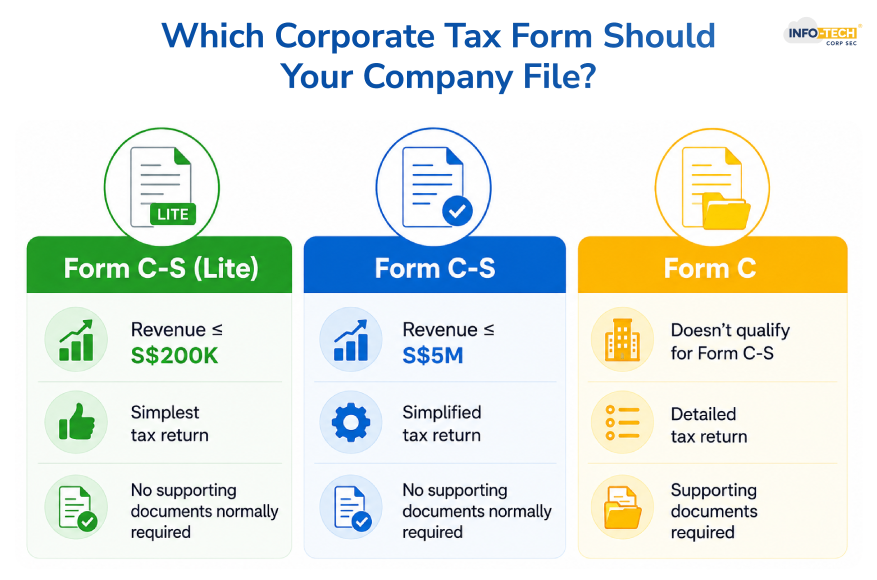
| Form C-S (Lite) | Eligible companies with revenue of S$200,000 or below | Generally not submitted unless requested |
| Form C-S | Eligible companies with revenue of S$5 million or below | Generally not submitted unless requested |
| Form C | Companies that do not qualify for Form CS | Financial statements, tax computation and relevant supporting documents |
So, smaller companies with straightforward tax affairs generally have a simpler filing process, while companies with more complex tax positions use it.
When Should the Forms Be Filed?
Companies are required to e-file their corporate income tax return by 30 November of each Year of Assessment (YA). This deadline applies to all forms. Companies should also remember that the filing requirement can apply even when the business made a loss. Businesses must also keep up with applicable ACRA requirements, including annual returns and statutory records, which can be managed through professional corporate secretary services.
Corporate tax returns should not be confused with Estimated Chargeable Income (ECI). ECI is a separate filing that generally needs to be submitted within three months after the end of the company’s financial year, unless the company qualifies for an exemption.
Read Also: Singapore Tax Bracket and Income Tax Rate in 2026
How Do You Prepare for Filing?
Before filing, make sure your company’s accounting and tax records are ready. This normally includes your financial statements, tax computation and any schedules or documents supporting the figures reported in the return.
You do not need to attach these documents, keeping them properly prepared is important in case IRAS requests them later. The person submitting the return should also have the appropriate Corppass authorization for Corporate Tax matters.
How Do You File a Form?
Corporate income tax returns are filed electronically through the IRAS myTax Portal. Once the person filing has the required Corppass authorization, the general process is to:
- Log in to myTax Portal.
- Select the relevant business tax account.
- Go to Corporate Tax.
- Select the appropriate Year of Assessment.
- Complete the applicable Form.
- Review the details before submitting the return.
Make sure the figures entered agree with the company’s accounts and tax computation before submission.
Which Corporate Tax Form Should Your Company Use?
For most businesses, choosing the right one comes down to the company’s revenue and tax situation.
If your company has revenue of S$200,000 or below and meets the eligibility conditions, Form CS (Lite) offers the simplest filing route. Eligible companies with revenue of S$5 million or below can use Form CS. Other companies will need to file Form C.
Whichever applies, preparing your accounts and tax computation early makes the filing process much easier and gives you time to correct any issues before the 30 November deadline.
For form filing, contact Info-Tech Corporate Services today!
Form C & Form C-S FAQs
Form C can be filed once IRAS opens corporate tax filing for the relevant Year of Assessment (YA), and it must be e-filed by 30 November of that YA.
To fill in Form C, log in to the IRAS myTax Portal with the required Corppass authorization, select the relevant Year of Assessment, enter your company’s income and tax details, attach the required financial statements, tax computation and supporting documents, review the information, and submit the return electronically.
To fill Form C with IRAS, the company generally needs to submit its financial statements, detailed profit and loss statement, tax computation and supporting schedules, along with any other documents relevant to specific tax claims or adjustments.
Form C is used to declare a company’s actual taxable income to IRAS and calculate the corporate income tax payable for the relevant Year of Assessment (YA).